asdasdasd




Good habits are created at school
It's no secret that our children and young people are becoming increasingly sedentary. Twenty years ago, no one worried about students sitting at desks during the school day. Rather, a sedentary student was the ideal for a calm study environment. Since the advent of computers, tablets, and mobile phones in children's everyday lives, the situation today is different. More and more reports signal young people's sedentary lifestyles and ill health. What can schools do to create a better study environment and health for students?
Sedentary lifestyle – a health hazard for our children
For many children and young people, sedentary behavior has increased so much that it is considered a global health risk. The World Health Organization (WHO) has issued a call to action and a so-called action plan to reduce sedentary behavior among our youth. Feel free to read more about the study and recommendations.
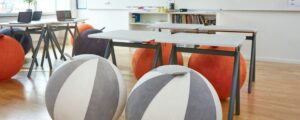
But there are fantastic opportunities to reduce sedentary behavior in the classroom with the right furnishings.
”In the adult work environment, we emphasize the importance of opportunities for varied and ergonomic working positions through Work Environment Directives. The workplace is often equipped with height-adjustable desks and various ergonomic aids. But what about our children and young people in school? What does their ”workplace” look like? Our children also spend a lot of time at their ”workplace.”
As if time had stopped
Unfortunately, the school environment hasn't changed much over the last 30-40 years. In most cases, the furnishings still consist of fixed desks and chairs with no possibility for variation or adaptation for the student. And for some students with special needs, the sedentary environment creates even greater challenges.
Build good habits in school
It is in our youth that we lay the foundation for the behaviors we later develop in adulthood. That is why it is important to create healthy habits already in school.
A sustainable approach is to give children the same good opportunities for movement and variation as adults, from an early age. By giving children the option to switch between sitting and standing during lessons, circulation and oxygenation increase. Because it is the movement done every day that makes a difference.
So instead of encouraging students to sit still, encourage them to stand up.
Invest in some height-adjustable school desks.
The ability to change position when ”legs are restless” means that children don't have to spend energy trying to sit still and can instead focus their attention on their tasks. When we stand, oxygenation increases, which leads to more alert students and better concentration.
Regular exercise improves reading comprehension
Several studies highlight immediate mental effects on students and the surrounding study environment. After just a few minutes of physical activity, improvements in concentration and reading comprehension are observed. Overall, activity and movement in school can increase learning by as much as 50 percent. This is partly because we remember and can concentrate better when blood circulation increases and the brain receives more oxygen and nutrients.
Regular exercise also releases more of the brain's feel-good hormones, while stress hormones get a natural physical outlet. This makes us more creative, resilient to stress, and positive towards actively participating in lessons, and less likely to disturb others.
Physical activity is also highlighted as “medicine” for children with diagnoses such as ADHD. By exercising for half an hour in the morning and having opportunities for movement at school, they can perform at the same level as children without a diagnosis.
Just as we applaud a baby when it stands up for the first time, we should continue to encourage children every time they get back on their feet, even during the school day.
Together we take the step
There are many great initiatives and collaborations aimed at increasing children's activity both in school and during their free time.
One is the work that the non-profit organization Generation PEP does, which you can Read more about it here.
Another example is our neighboring country Finland, where the Ministry of Education and Culture has announced development grants to make physical activity a part of the school day. Read more here.
Let's ensure that our children also have the right to an ergonomic and healthy study environment.