asdasdasd




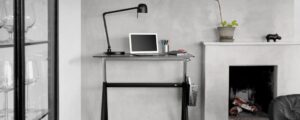
The home office – a health trap?
This is how to avoid your home office becoming a health hazard! Working from home can have many advantages. However, it can also lead to negative health effects and become costly if we do not take responsibility for the physical work environment. We have gathered facts and tips regarding the design of the home workspace.
Who is responsible for the home office?
There is no doubt today that the work environment is an important responsibility for the employer. However, what not as many people know is that the Work Environment Act makes no distinction as to whether the work is performed at the company or at home. It is always the employer's responsibility to ensure that the home workplace functions in a sustainable and flexible manner, not least ergonomically.
Some recommendations can include, for example, height-adjustable desks to give the employee the opportunity to vary their working posture throughout the day, equipment for active standing or sitting, access to proper lighting, and the ability to raise their screen to avoid injuries.
Flexible, stylish, and healthy interior design
Most office furniture today is designed for office environments. When it now needs to find a place in the home, it is not adapted for such a setting. Office desks and chairs are often heavy and bulky, and their color schemes may not be suited for home decor. It's time to develop flexible, stylish, and healthy furniture that we can be proud to display in our homes.
Furniture in the home encourages us to sit down
When most of the population started working from home, no one was really prepared. The first thing that happened was that we invested in digital tools to stay in touch, work efficiently, and hold meetings.
Unfortunately, the physical work environment is being neglected. Naprapaths, massage therapists, and doctors testify that the number of people seeking help for neck and back problems has increased dramatically. One of the main reasons is that most of our homes are not designed for working in.
Another important parameter is that we are not as active as when we are in the office. We don't have to walk over to a colleague across the room or cycle to work.
Another factor is that the furniture in the home is made for relaxation and sitting. It encourages a sedentary lifestyle. The home's decor is not designed to sustain concentration and focus for several hours.
Incorrect loading affects our ability to work.
Increased sedentary behavior creates problems in our bodies. When we sit down at the kitchen table or on the sofa, the lower back tends to collapse. Our thighs get squeezed, and circulation deteriorates. The brain gets less access to oxygen. Furthermore, our spine is negatively affected when we hunch forward if the table is not in an ergonomically sound working position. When we have the laptop on our lap, we bend our neck down, creating tension in the back and neck.
Overall, these and many other factors mean that we cannot perform as well during our working hours.
Our concentration wavers, we become tired from reduced movement and oxygenation, and stiffness and low circulation create problems.
”The ability to stand up and work, reducing sedentary behavior, is just as important at home as it is in the office. When we work from home, the daily walk or bike ride to and from work, as well as many other natural everyday movements, also disappear. With an active workspace at home, we feel better, perform more, and prevent injuries.“
This is what the employee thinks
According to the research firm Leesman (which measures workplace experiences) and their latest study on the home office, we see that one of the most critical and significant factors for experiencing successful remote work is access to a specific workspace. Either a dedicated desk area or a private office with a desk.
The importance of good physical equipment therefore means a great deal for the efficiency and perceived experience of the employee. Not least, it is important from an occupational health and safety perspective to reduce the risks of injuries and costly rehabilitation cases.
Here's how to create a healthy home workspace
- Create a dedicated workspace/area – helps create the feeling of “coming and going” from work, reduces stress from the feeling of taking up common areas in the home.
- Vary between standing and sitting – reduces strain injuries.
- Provide space and encourage brief movement and recovery breaks.
- Get the right light – a desk lamp ensures good illumination.
- Ensure good ergonomics – the correct screen height, ergonomic keyboards, and mice relieve pressure on your shoulders, arms, and neck.